
Veronica French
How to Integrate Bioprocess Data Across Sites, Systems, and CDMOs | Invert Bioprocess AI

How to Integrate Bioprocess Data Across Sites, Systems, and CDMOs — Without the Headache
Bioprocessing rarely happens in one place. It spans research labs, pilot plants, GMP facilities, and CDMOs — each with its own systems, file formats, and data conventions. Every organization wants unified, analysis-ready bioprocess data, yet most scientists still spend hours stitching together files from bioreactors, downstream systems, LIMS exports, and email attachments from external partners. What should be a continuous data pipeline often becomes a patchwork of spreadsheets, ad-hoc scripts, and fragile workflows that break whenever something changes.
This fragmentation slows development, increases compliance risk, and forces teams to rely on stale insights when making critical decisions. Integrating bioprocess data shouldn’t require months of custom engineering or manual cleanup from scientists. And with the right architecture, it doesn’t.
The Real Integration Problem: Bioprocess Data Behaves Differently
Most integration tools were built for transactional records or low-frequency scientific data — not the massive, high-density time-series streams generated by modern bioreactors and DSP systems. They don’t understand batch context, sampling workflows, or process lineage. They weren’t made to accommodate CDMO variability or the regulatory expectations of 21 CFR Part 11 and GxP. And they certainly weren’t built to harmonize data in real time.
This is why generic integration frameworks, retrofitted LIMS systems, and internal IT builds often fail. They’re not aligned with the realities of USP, DSP, and scale-up, and they place the burden of cleanup on scientists instead of automating it at the source.
The Modern Playbook for Seamless Bioprocess Data Integration
1. Integrate With LIMS — Don’t Replace It
LIMS is essential for sample tracking and compliance, but it’s not designed for bioreactor time-series data, DSP traces, or real-time contextualization. The right bioprocess platform augments LIMS rather than competing with it. It captures complexity upstream — harmonizing sensor data, events, sampling, and metadata — and delivers structured outputs back into the LIMS environment. This approach strengthens traceability, reduces manual correction, and lays the groundwork for AI-ready datasets that extend far beyond what the LIMS alone can support.
2. Unify Data Across Sites and Instruments Automatically
The single biggest step forward for most organizations is removing the manual effort involved in merging data. A modern integration layer ingests data from bioreactors, analyzers, and DSP equipment across all sites — including CDMOs — and harmonizes it automatically. Instead of reconciling naming conventions or aligning timestamps by hand, scientists receive consistent, structured, contextualized datasets ready for analysis. This level of unification is essential for reproducibility, comparability, and scale-up decisions.
3. Build Integration Pipelines That Adapt, Not Break
Bioprocess environments change constantly. Instruments get firmware updates, CDMOs adjust their formats, and different teams may use slightly different workflows. Hard-coded pipelines fail the moment any of these variables shift. Scalable integration requires flexible mappings and prebuilt connectors that absorb variability without disrupting data flow. This is precisely where homegrown systems struggle and why mature teams adopt purpose-built platforms that anticipate the realities of bioprocessing rather than forcing rigid structures on it.
4. Make CDMO Collaboration Repeatable and Traceable
Most organizations still exchange critical manufacturing data with CDMOs via emails, flat files, or shared folders — workflows that commonly lead to missing metadata, inconsistent structures, and delayed insights. A robust integration layer standardizes CDMO inputs automatically, preserving lineage and process context even when partners use different templates or tools. This gives internal teams real-time access to CDMO data and dramatically reduces risks during tech transfer and scale-up.
5. Free Scientists and IT From Manual Data Work
When scientists serve as data janitors and IT teams maintain brittle pipelines, progress slows. Automation must replace manual reconciliation, error handling, and formatting. A platform that performs ingestion, harmonization, mapping, and contextualization without human intervention shifts scientific time back to experimentation and engineering. This is central to Invert’s philosophy: Automation That Frees Expertise — empowering teams to advance discovery and scale-up instead of fighting with data.
Where Invert Fits: Integration Without the Headache
Invert is Bioprocess AI Software designed specifically to unify, harmonize, and contextualize bioprocess data across instruments, systems, sites, and CDMOs. Unlike generic tools or retrofitted LIMS/ELN extensions, Invert was engineered for the realities of USP, DSP, tech transfer, and scale-up.
Invert integrates seamlessly with existing LIMS environments, enhancing them with richer, more reliable data rather than attempting to replace them. Its prebuilt connectors for bioreactors, analyzers, DSP equipment, and CDMOs allow teams to go live in hours, giving IT a reliable, validated pipeline instead of a long, risky project. Underneath, Invert continuously harmonizes and contextualizes all incoming data, creating a trusted foundation that is traceable, reproducible, and ready for AI-driven analysis.
Because insights are only as good as the data beneath them, Invert ensures that scientists and engineers work with consistent, contextualized datasets — not a collection of inconsistent exports. Real-time visibility into USP and DSP runs becomes standard, and CDMO collaboration becomes predictable rather than a constant source of variability. Most importantly, scientists finally spend their time running experiments instead of fixing files.
Why CMOs and CDMOs Choose Invert
Manufacturers serving multiple clients must manage variability across programs, instrumentation, and regulatory expectations. Invert allows CDMOs to standardize their data delivery, improve traceability, reduce investigation cycles, and raise the quality of data they return to sponsors — without increasing operational or IT burden. In a competitive market, CDMOs that deliver clean, harmonized, ready-to-analyze datasets stand apart. Invert makes that possible.
Conclusion: Integration Should Be a Capability, Not a Project
Bioprocess data integration should not depend on manual cleanup, fragile pipelines, or months of configuration work. When handled correctly, it becomes an automated, scalable capability that supports every stage of development — and accelerates scale-up rather than slowing it down. With unified, contextualized, real-time data flowing across instruments, LIMS systems, internal sites, and CDMOs, organizations make faster, more confident decisions and reduce risk across the entire lifecycle of bioprocess development.
Request an Integration Walkthrough
See how Invert integrates your bioprocess data across systems, sites, and CDMOs — without manual cleanup or IT overhead.
.png)
Engineer Blog Series: From Bioprocess to Software with Anthony Quach
Welcome to Invert’s Engineer Blog Series — a behind-the-scenes look at the product and how it’s built.In this post, software engineer Anthony Quach shares how his career in bioprocess development led him into software, and how that experience shapes the engineering decisions behind Invert.
Read More ↗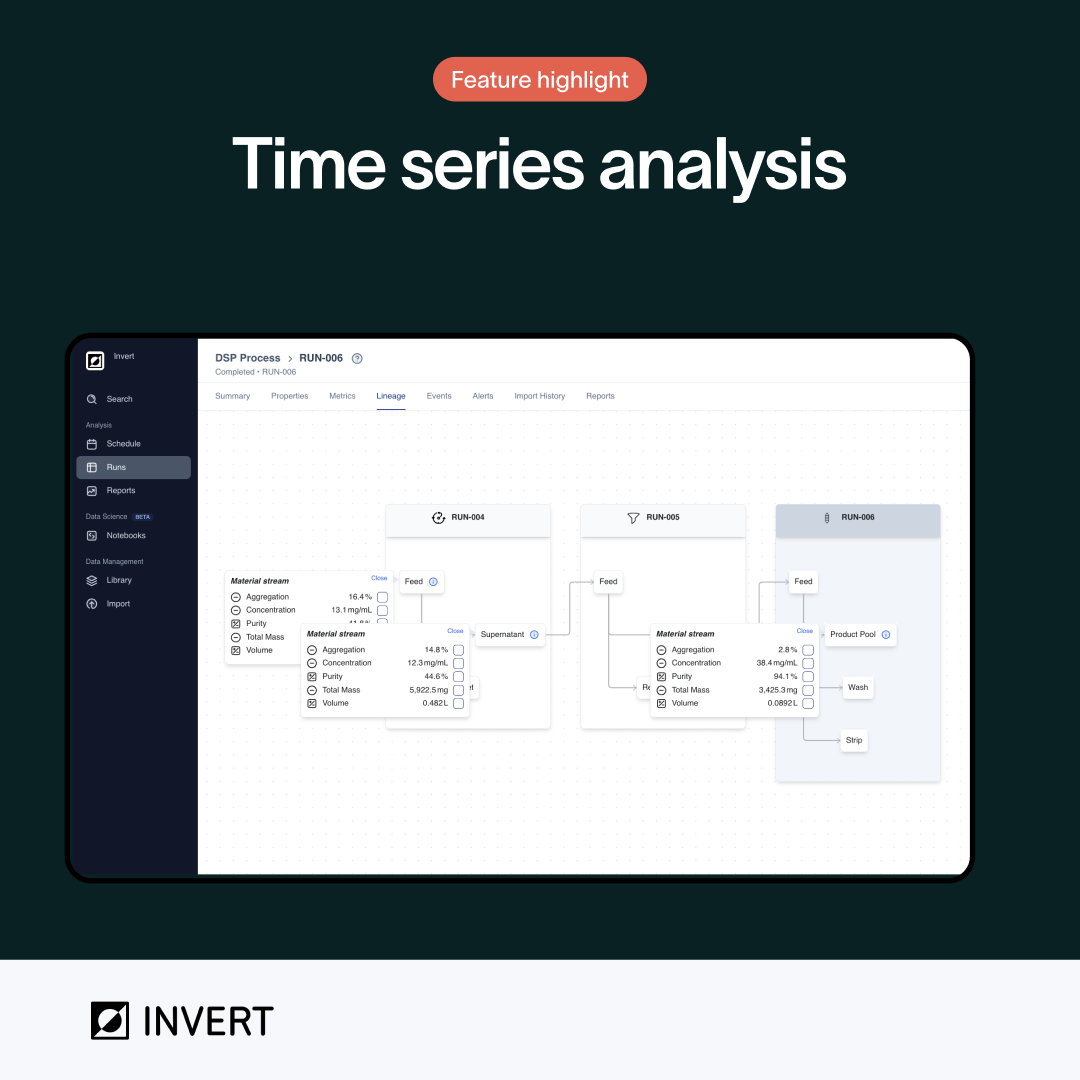
Connecting Shake Flask to Final Product with Lineage Views in Invert
Invert’s lineage view connects products across every unit operation and material transfer throughout the entire process. It acts as a family tree for your product, tracing its origins back through purification, fermentation, and inoculation. Instead of manually tracking down the source of each data point, lineages automatically show material streams as they pass through each step.
Read More ↗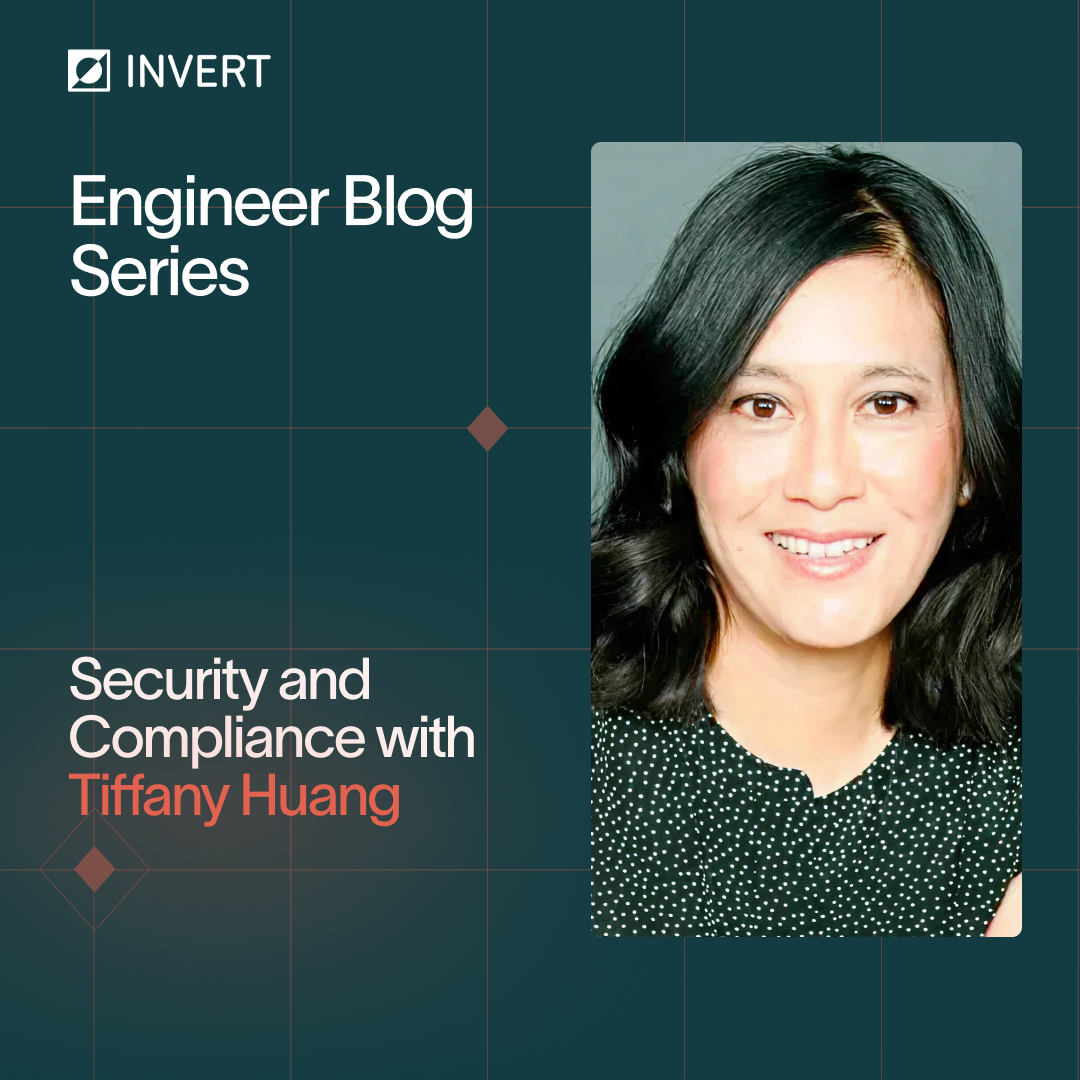
Engineer Blog Series: Security & Compliance with Tiffany Huang
Welcome to Invert's Engineering Blog Series, a behind-the-scenes look into the product and how it's built. For our third post, senior software engineer Tiffany Huang speaks about how trust and security is a foundational principle at Invert, and how we ensure that data is kept secure, private, and compliant with industry regulations.
Read More ↗