
Veronica French
What Is Bioprocess AI? How Artificial Intelligence Is Transforming Manufacturing Intelligence

The Rise of Bioprocess AI
Bioprocessing has always been the beating heart of biomanufacturing. From upstream cell culture to downstream purification and formulation, every phase generates an enormous volume of data. Yet most of that data sits unused, scattered across instruments, spreadsheets, and sites.
Artificial intelligence (AI) in bioprocessing, or Bioprocess AI, has emerged to solve that. It’s not just about analytics or automation. It’s about creating an intelligence layer that turns raw, fragmented data into trusted, real-time insight. The outcome is faster, more confident decisions that directly accelerate time to milestone and product launch.
Platforms like Invert are pioneering this category by combining deep bioprocess domain expertise with world-class technology. Instead of forcing teams to adapt generic tools, Bioprocess AI software is designed from the ground up for the complexities of USP, DSP, and scale-up manufacturing.
Why Bioprocessing Needs AI Now
Biopharma’s data challenge isn’t about volume, it’s about usability. Every bioreactor, sensor, and chromatography skid generates continuous time-series data, but those data streams often live in silos.
Scientists spend countless hours cleaning and merging data manually, delaying analysis until long after a run is complete. That delay means missed insights, wasted batches, and slower tech transfer. Meanwhile, manufacturing teams lack the real-time visibility needed to adjust parameters mid-process or predict deviations before they occur.
AI changes that equation by enabling live, contextualized intelligence. When built on a unified data foundation, AI models can surface anomalies, predict yield trends, and recommend corrective actions as events unfold, not days later.
This evolution mirrors what’s already happened in other advanced manufacturing sectors. Automotive, aerospace, and energy have all transitioned from static data review to dynamic, AI-supported process optimization. Bioprocessing is following the same path, but with higher stakes and stricter regulatory requirements.
How Bioprocess AI Software Works
At its core, Bioprocess AI integrates three essential capabilities:
1. Unified, AI-Ready Data Foundation
The foundation begins with data harmonization. A modern platform continuously ingests data from instruments, historians, LIMS, and CDMOs, then harmonizes and contextualizes it in real time. That process transforms fragmented data into a structured, reproducible, and compliant dataset ready for analytics and AI models.
This foundation also supports full traceability, ensuring every decision can be audited and every result can be reproduced, a must for GMP and 21 CFR Part 11 compliance.
2. Built-In Intelligence Layer
Once data is unified, the intelligence layer activates. Real-time visualization, advanced analytics, and transparent AI models transform complex datasets into interpretable insights. Scientists and process engineers can monitor bioreactors live, compare runs instantly, and detect subtle process shifts before they become deviations.
Platforms like Invert’s intelligence layer integrate these capabilities natively, eliminating the need for separate BI dashboards or fragile custom pipelines.
3. Closed-Loop Decisioning
The final evolution is closed-loop decision support, where insights feed directly into process control, optimization, and digital twin models. This continuous learning cycle connects development and manufacturing, helping organizations move from reactive troubleshooting to proactive process control.
The Impact: From Development to Commercial Scale
When applied correctly, Bioprocess AI delivers measurable benefits across the entire lifecycle:
- Faster scale-up: Real-time analytics shorten the feedback loop between R&D and manufacturing, cutting time to milestone.
- Improved yield and consistency: Predictive modeling identifies parameter interactions that drive variability, improving process robustness.
- Reduced cost and risk: Early anomaly detection prevents wasted runs and reduces the likelihood of batch failure.
- Regulatory confidence: AI-ready data structures and audit trails simplify documentation and validation for quality and compliance teams.
- Empowered teams: Scientists spend less time reconciling spreadsheets and more time running experiments that matter.
A recent ISPE Biopharmaceutical Manufacturing Trends report highlighted digital transformation and AI adoption as top priorities for process development teams over the next five years. The companies that succeed will be those who build a trusted data foundation early.
Real-World Example: Connecting Development and Scale-Up
Consider a mid-size biopharma scaling a monoclonal antibody process from pilot to GMP production. Traditionally, the tech transfer involves multiple handoffs, each introducing risk, data loss, and manual reconciliation.
With a Bioprocess AI platform, all development and pilot data remain unified, contextualized, and accessible through a shared intelligence layer. During scale-up, the manufacturing team can instantly compare new runs against historical models, visualize performance trends, and detect drifts in cell viability or metabolite consumption in real time.
That visibility enables faster decision-making and a smoother path from development to commercial readiness. In short, Bioprocess AI bridges the long-standing gap between data and decisive action.
Choosing the Right Bioprocess AI Platform
Not all AI software is created equal. Many generic BI or LIMS tools offer visualization but lack the contextualization and automation bioprocessing demands.
When evaluating solutions, organizations should look for:
- Purpose-built design: Software architected specifically for bioprocessing, not retrofitted from other industries.
- Dual expertise: Teams who combine real bioprocess experience with enterprise-grade technology know-how.
- Native intelligence layer: Real-time analytics, visualization, and transparent AI built directly into the platform.
- Fast, low-risk deployment: Prebuilt connectors for common instruments and CDMOs, minimizing IT burden.
- Trusted data foundation: Continuous ingestion and harmonization to ensure accuracy, traceability, and compliance.
Invert’s Bioprocess AI Software checks all of these boxes. Designed by experts who have lived both sides of bioprocess and technology, it transforms fragmented data into reliable, actionable insights, delivered instantly, without heavy IT lift.
The Future of Bioprocess Intelligence
The next frontier of manufacturing intelligence is live, connected, and explainable. The future bioprocess facility won’t just collect data; it will learn from it in real time. AI models will continuously optimize yield, resource efficiency, and sustainability.
But success won’t come from AI alone, it will come from trusted data foundations, transparent intelligence, and human expertise guided by insight.
Bioprocess AI isn’t replacing scientists or process engineers. It’s amplifying their impact by freeing them from data wrangling and enabling them to make faster, more confident decisions.
That’s the promise of Invert: turning complexity into clarity, accelerating progress from development through scale-up, and helping bring life-changing therapies to market faster, because waiting is no longer an option.
.png)
Engineer Blog Series: From Bioprocess to Software with Anthony Quach
Welcome to Invert’s Engineer Blog Series — a behind-the-scenes look at the product and how it’s built.In this post, software engineer Anthony Quach shares how his career in bioprocess development led him into software, and how that experience shapes the engineering decisions behind Invert.
Read More ↗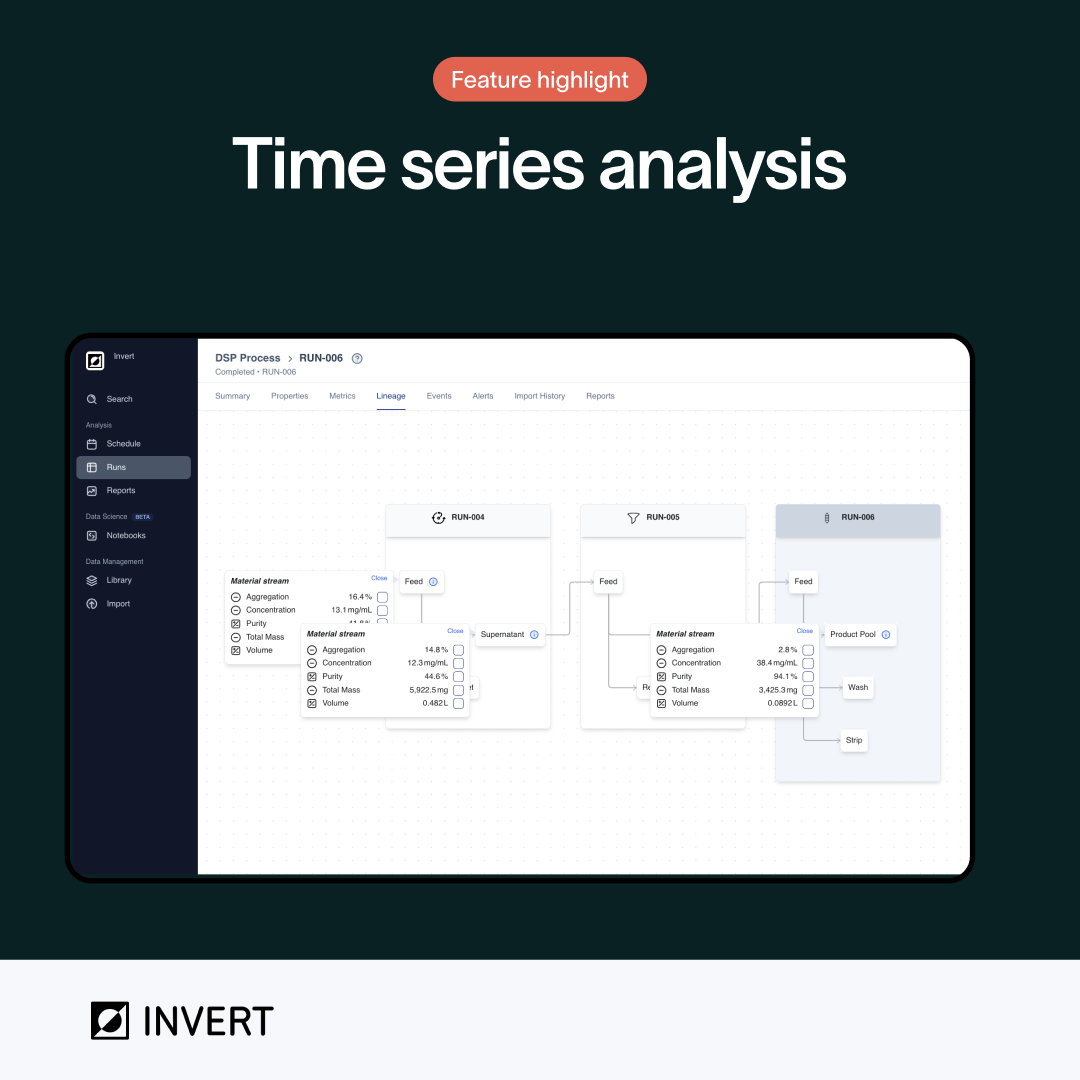
Connecting Shake Flask to Final Product with Lineage Views in Invert
Invert’s lineage view connects products across every unit operation and material transfer throughout the entire process. It acts as a family tree for your product, tracing its origins back through purification, fermentation, and inoculation. Instead of manually tracking down the source of each data point, lineages automatically show material streams as they pass through each step.
Read More ↗
Engineer Blog Series: Security & Compliance with Tiffany Huang
Welcome to Invert's Engineering Blog Series, a behind-the-scenes look into the product and how it's built. For our third post, senior software engineer Tiffany Huang speaks about how trust and security is a foundational principle at Invert, and how we ensure that data is kept secure, private, and compliant with industry regulations.
Read More ↗